Remediable Payments
Overview
Reframing payment recovery from a customer support function into a scalable product capability.
Team
AP Trust
Role
Product designer
Duration
12 weeks
Problem
Failures lacked clarity and ownership.
Payment failures were treated as isolated edge cases handled by support rather than a coherent product experience. Customers had no clear understanding of why payments failed, whether they were recoverable, or what actions to take next.
This created unnecessary support volume, delayed payment resolution, and eroded trust in BILL as a reliable payments platform. Internally, recovery workflows were fragmented across teams, making it difficult to scale or standardize remediation.
Remediable payments were hidden as "Failed."


Strategy
Unify recovery into a reusable product pattern.
I reframed payment recovery as a reusable product capability instead of separate workflows for each failure type.
The approach focused on four principles:
1. Clearly separating recoverable from permanent failures,
2. Translating technical errors into plain language
3. Enabling in-context resolution without disrupting the workflow, 4. Designing patterns that could scale to future payment issues.
This shifted recovery from a reactive support function into a core product capability.

Solution
A unified system for in-context remediation.
designed the Needs Attention framework to proactively surface recoverable payments, prioritize urgency, and guide customers through contextual remediation directly within their workflow.
The system unified multiple failure scenarios—including invalid bank accounts, undeliverable checks, and insufficient funds—into a consistent recovery model.
Reusable patterns for explanation, decision-making, and resolution allowed teams to ship new failure types without redesigning the experience each time.
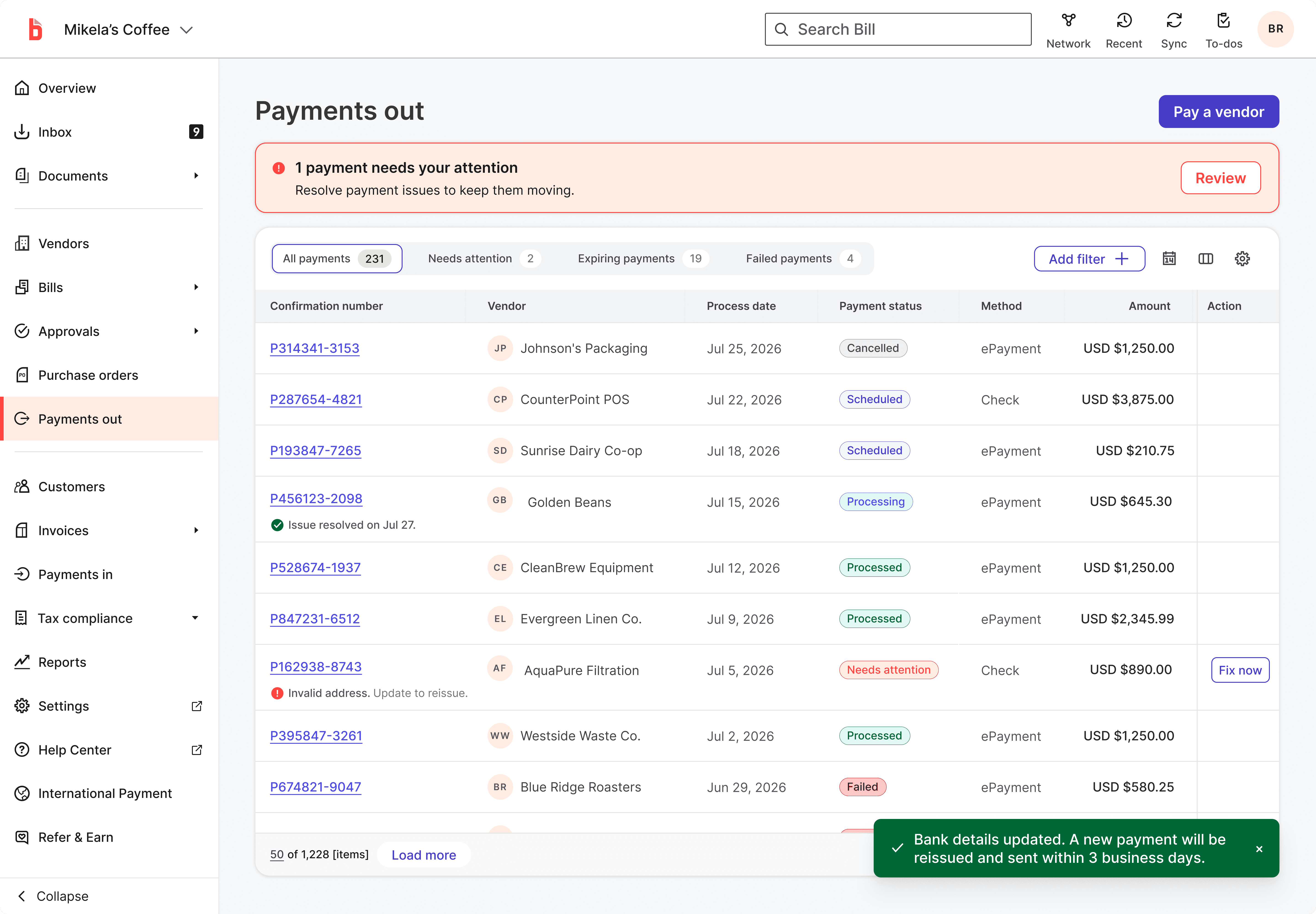
Distinguishing remediable payments from failed payments

Adding an error icon, contextual description and a 'Fix now' button

Reinforcing with a banner

Contextual side drawer that scales for every issue type

Confirmation toast
Results
Fewer tickets, faster recovery, Improved trust.
Self-service remediation reduced payment-related support contacts from approximately 12,000 to 7,200 per month, while increasing successfully reissued payments by 53%.
Customers were able to resolve issues directly within BILL instead of relying on support, improving trust and reducing operational overhead.
The framework also established a scalable foundation for handling future payment exceptions consistently across the platform.

Reflection
From workflows to a platform capability.
The most meaningful outcome was not the interface itself, but the shift in how payment recovery is owned and scaled. It moved from a collection of fragmented support workflows to a unified product capability.
If I were designing this today, I would extend the system into an AI-assisted orchestration layer that predicts failures earlier, recommends remediation automatically, and reduces customer effort to near-zero while keeping humans in the loop for high-risk decisions.
More on this if we get to chat during screening!